
How to Build a Content Calendar for Multiple Clients

When my business partner and I started our agency, the work we expected to be hardest (designing, writing, scheduling) turned out to be the easy part. The thing that actually kept me up at night showed up like clockwork every month. A blank content calendar for every brand, waiting to be filled with good ideas all over again.
With one brand, you can get by on inspiration. With ten or fifteen, you can’t. Inspiration doesn’t show up on demand, and when deadlines close in, it’s tempting to fill the gaps with empty posts, the kind that look nice but don’t teach anything or spark any engagement. Clients notice that filler, and so does the algorithm.
Over the years, through a lot of practice and a lot of research (reading articles, following people who know their stuff, learning on YouTube, taking courses), I figured out the best way to build content calendars for several clients at once. Here’s what I learned, with tables and examples you can copy, and at the end I’ll tell you which tool I use to handle it today.
Why You Run Out of Ideas When You Manage Many Clients
Before we get into it, it’s worth looking at why this happens, because it’s almost never a lack of creativity. It comes down to four process problems:
- Coming up with ideas one post at a time. You sit down to invent post after post, and by the tenth one of the day, the well is dry.
- Context switching. Jumping from a dental clinic to a coffee shop to a clothing brand several times a day wears out your brain before your hands.
- A full calendar instead of a valuable one. You plug the gaps with generic lines that say nothing, and it shows in the accounts.
- No starting point, so you start from scratch. Every month is a blank page because nothing from last month left you a foundation to build on.
Clients don’t pay for a full calendar. They pay for content that makes them look good, connects with their audience, and makes sense for their business. Everything below tackles those four problems, one by one.
What I Learned About Never Running Out of Ideas
What I realized is simple. Fresh ideas don’t depend on inspiration striking. They depend on having a foundation to start from and a few lenses to multiply it. There are six practices, and I’ll walk you through them using one example brand, a dental clinic, so it doesn’t stay abstract.
1. Define Content Pillars for Each Brand
The number one cause of creative block is always starting from zero, and content pillars prevent that. They’re the three to five core themes a brand can always talk about. You find them where three things overlap: what the brand sells, the problems its audience has, and its personality. Each pillar has to pass three tests. You can produce it month after month without running dry, it ties back to a business goal, and it doesn’t overlap with the others.
Here are the dental clinic’s pillars, what each one covers, and what it’s for.
| Pillar | What it covers | What it’s for | Example topic |
|---|---|---|---|
| Education | Questions, myths, how each treatment works | Attract people who are still researching | ”Does teeth whitening damage enamel?” |
| Trust | Team, facilities, process, safety protocols | Ease people’s fear of the dentist | A day at the clinic through a patient’s eyes |
| Results | Real cases, before and afters, testimonials | Prove it actually works | Before and after braces |
| Offer | Services, pricing, promos, financing | Convert people who are ready to book | What’s included in your first visit |
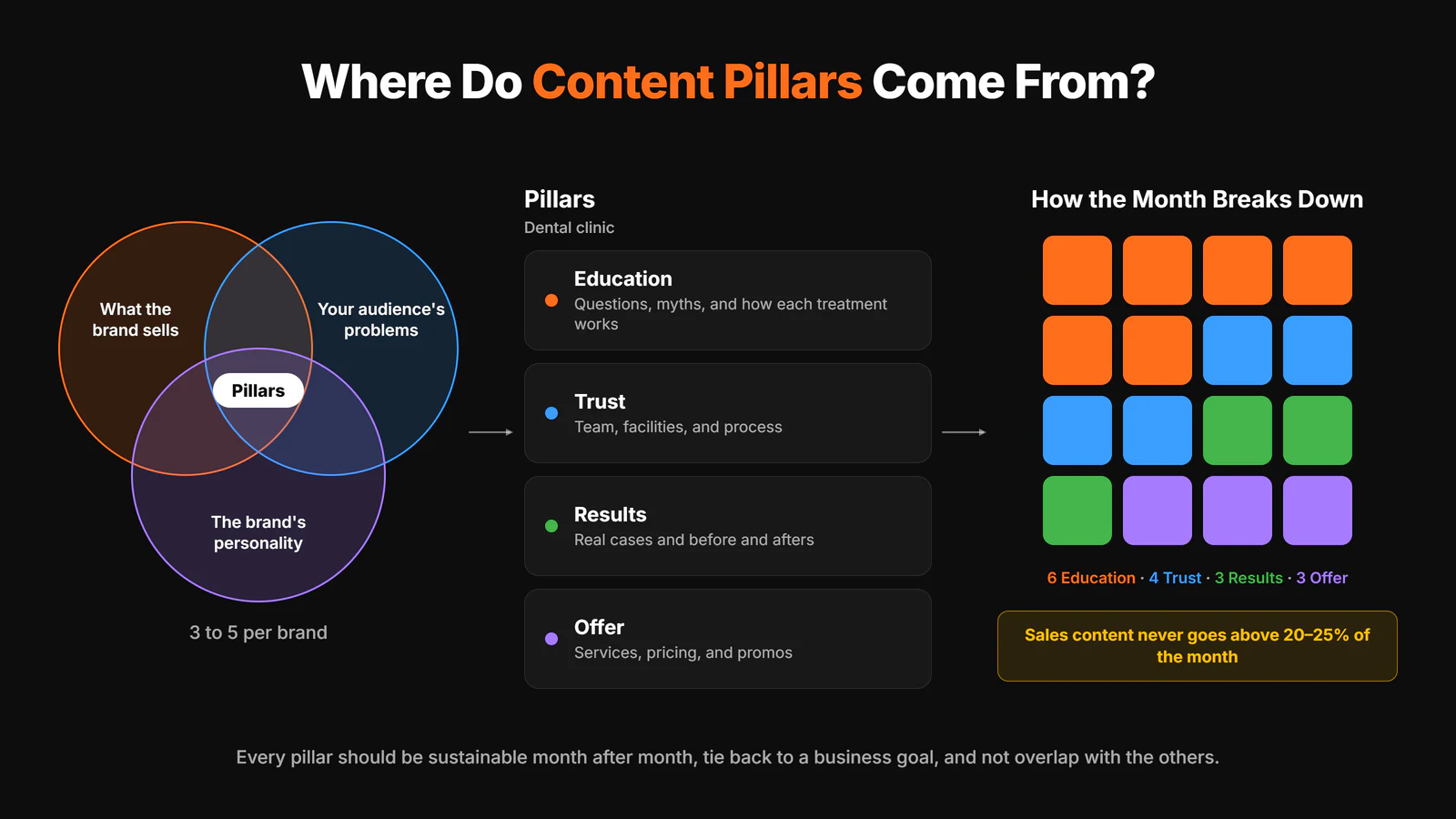
My rule of thumb for a month of about 16 posts is roughly 6 education, 4 trust, 3 results, and 3 offer. The one rule I never break is that sales content stays under 20 or 25 percent, or the account turns into a catalog and people stop paying attention.
If the brand is brand new and has almost no followers or reach, I cut sales content even further, down to about 10 percent, or two posts a month. At that stage, organic content has to win people over, and the direct selling is usually already being handled by Meta ads running separately. As the account grows and reach picks up, I gradually increase the share.
Even then, a sales post doesn’t have to look like an ad. Instead of the classic “This month’s promo, book now,” I sell with something that’s also useful, like what’s included in the first visit, how long a treatment takes and why, or the story of a patient who came in with the same question. People still buy, they just don’t feel sold to.
2. Keep an Idea Bank Going All Month
The mistake is treating ideation as a monthly event, where you sit down one day and squeeze your brain dry. What works is the opposite. Capture ideas constantly and only assemble the calendar once a month. I keep one doc per brand in Google Drive and jot down raw material the moment it shows up. Keeping it in Drive is intentional. If you work with other people, the whole team can add to it and check it at the same time, and ideas don’t stay stuck in one person’s head or phone. These are my go-to sources.
| Where I look | What I capture | Real example |
|---|---|---|
| Questions during appointments and sales calls | The exact question, in their words | ”Does getting a tooth pulled hurt?” |
| Comments and DMs | Objections and things people are curious about | ”Do you offer payment plans?” |
| Reviews, yours and competitors’ | What people value and what let them down | ”They explained everything before starting” |
| Google autocomplete and “People also ask” | How people search for the topic | ”teeth whitening cost” |
| TikTok and YouTube search | What people search for and how others have already covered it | Type “teeth whitening” and you get suggestions plus dozens of videos with different takes |
| AI (ChatGPT, Claude, or whatever you use) | A first batch of ideas to filter with your own judgment | ”Give me 20 questions people have before whitening their teeth” |
| The front desk team | What they get asked ten times a day | Hours, emergencies, what to bring |
If you want to take it a step further, try AnswerThePublic. Type in a topic, say “teeth whitening,” and it shows you the questions people ask search engines, grouped by type (what, how, how much, why), plus comparisons like “teeth whitening vs veneers.” The free version lets you run a few searches a day, and a single search can give you angles for weeks.
Two habits make a big difference. I capture ideas in the client’s exact words, not mine, so the content sounds like their world. And I tag each idea with its pillar the moment I write it down, so it’s already half organized when it’s time to plan.
3. Break Each Topic Into Angles, Not One-Off Posts
This is the trick that multiplies everything. Between the pillar and the post, there’s a step almost nobody uses, the angle. The pillar is the broad topic, the angle is the specific take, and that’s where the post comes from. One topic doesn’t give you one post. It gives you ten, depending on the lens you look through.
Take one clinic topic, “teeth whitening,” and watch it open up.
| Angle (the lens) | Specific idea | Format | Goal |
|---|---|---|---|
| Myth | No, whitening doesn’t wear down your enamel when a professional does it | Reel | Educate |
| Common mistake | 3 things you do at home that stain your teeth | Carousel | Educate |
| Pricing / what’s included | What a whitening treatment includes and why prices vary | Carousel | Sell |
| Before and after | A real patient’s results, shared with permission | Reel | Inspire |
| Who it’s NOT for | When you shouldn’t whiten your teeth, and what to do first | Story | Connect |
| Step by step | What a session looks like, minute by minute | Reel | Connect |
| Comparison | In-office whitening vs drugstore kits | Carousel | Educate |
One topic just turned into more than a week of content. Best of all, these lenses work for any brand and any topic. This is my go-to list, I apply it to everything and never run out of angles: myth, common mistake, step by step, before and after, comparison, pricing or what’s included, who it’s not for, checklist, real case, FAQ, and mini story.
That’s why it pays to separate ideation from production. First I fill the month at the angle level, quickly and in one go, and then I sit down to execute. Mixing the two is what makes the process slow and exhausting.
4. Use a Goal-by-Format Matrix
Having lots of angles isn’t enough if they all pull in the same direction. So the month doesn’t end up as thirty versions of the same post, I cross two axes in a grid, the goal (educate, inspire, entertain, connect, sell) against the format (Reels, carousels, Stories, single images). I fill each cell with a real idea, and at a glance I can see whether the month is balanced or whether everything piled up under “sell.”
Here’s the clinic’s matrix, with one idea per cell.
| Reel | Carousel | Story | Single image | |
|---|---|---|---|---|
| Educate | The whitening myth in 20 seconds | 5 signs you’re due for a cleaning | Poll: “How often do you see the dentist?” | A stat on how common dental anxiety is |
| Inspire | A smile transformation | A patient who overcame their fear of the dentist | A message from the team about why they do what they do | A quote from a happy patient |
| Entertain | Types of patients in the waiting room | Dentist myths you’ve seen in movies | ”True or false?” quiz | A dental meme in the brand’s voice |
| Connect | Meet the team | Behind the scenes of a cleaning | Question sticker: “Ask the dentist” | A candid photo of the team at work |
| Sell | A clinic tour and how to book | What’s included in your first visit | Countdown to a promo | This month’s promo |
The test is visual. If a row or column is empty or overloaded, I rebalance before producing anything. This one table is what guarantees variety without having to think about it every time.
5. Reuse Angles Across Clients, Adapted to Each One
This is the advantage of managing multiple accounts. An angle that worked for one can become a template for another. It’s not copy and paste. You reuse the structure and dress it up with each brand’s context and voice. Here’s the same structure served to three different clients.
| Structure that worked | Dental clinic | Specialty coffee shop | Clothing brand |
|---|---|---|---|
| ”3 myths about ___“ | 3 myths about teeth whitening | 3 myths about decaf | 3 myths about washing your jeans |
| ”What ___ really costs” | What you’re paying for with braces, and why | Why specialty coffee costs more | Why well-made clothing costs more |
| ”A day at ___“ | A day at the clinic | A day at the roastery | A day at the workshop |
What would be repeating yourself with one client becomes leveraging what you already know works when you have several. A good structure pays for itself for months.
6. Anchor the Month to the Calendar
The best ideas don’t float in the air. They hang on something. Before I fill anything in, I mark the month’s anchors, like industry dates, seasons, launches, and client promos. Those anchors give each post a reason to exist on that exact day, and they fill a good chunk of the calendar on their own. Anchors first, then pillars and angles on top.
Put it all together and here are the clinic’s first two weeks, with every post coming from the pillars and lenses, not from whatever inspiration struck that day.
| Day | Pillar | Angle | Format | Goal |
|---|---|---|---|---|
| Mon 1 | Education | The whitening myth | Reel | Educate |
| Wed 3 | Trust | Meet the team | Carousel | Connect |
| Fri 5 | Results | Before and after braces | Reel | Inspire |
| Sat 6 | Offer | What’s included in your first visit | Carousel | Sell |
| Mon 8 | Education | 3 mistakes that stain your teeth | Carousel | Educate |
| Thu 11 | Education | ”True or false?” quiz | Story | Entertain |
| Sat 13 | Offer | This month’s promo | Single image | Sell |
Running out of ideas is almost never a lack of creativity. It’s not having a place to start. With pillars, a living idea bank, angle lenses, and a variety grid, the month practically plans itself.
How to Filter for Ideas That Actually Add Value
A calendar full of ideas is useless if they’re empty. Before I sign off on a month, every post goes through three questions, brand by brand:
- Does it solve something or add value for the audience? It teaches, entertains, or answers a question. If it just fills a slot, it’s out.
- Does it sound like this brand? If the same post could live on any competitor’s account, it’s missing identity.
- Is there real variety across the month? The matrix tells you. If it isn’t spread out, something has to go.
A quick way to apply the first filter is to read each idea as if you were someone in the audience scrolling past, and ask yourself, “What’s in it for me?” If the answer is concrete (I learn something, I laugh, it clears up a question), the idea stays. If the answer is “nothing,” it’s filler, no matter how pretty it looks. “Happy Monday from the clinic” doesn’t pass. “3 things you do at home that stain your teeth” does, because whoever sees it walks away with something they can use that same day.
And once the calendar is ready, the client still has to approve it. Here is how to speed up content approvals with your clients.
How I Build the Content Calendar in Portal Orange
You can do everything above with docs and discipline. That’s how I did it for years. The problem is that with many clients, keeping each brand’s pillars, idea bank, rules, and calendar up to date becomes a job of its own, and once we passed fifty clients, that was our bottleneck. Portal Orange was born right there, out of bringing together everything we’d learned at the agency and turning it into a tool. Instead of an AI that just polishes your copy, we wanted one that suggests ideas from scratch and already knows what each client is about, without you having to explain it every time.
Where the context comes from. It all starts with a brief the client fills out, however basic it is. The AI takes that brief and turns it into a real marketing plan, with goals, audience, pillars, and tone. That plan, plus everything you add over time (what works, the rules, what the client can’t stand), becomes the brand’s living context, and it lives in one place instead of in the head of someone who might leave one day.
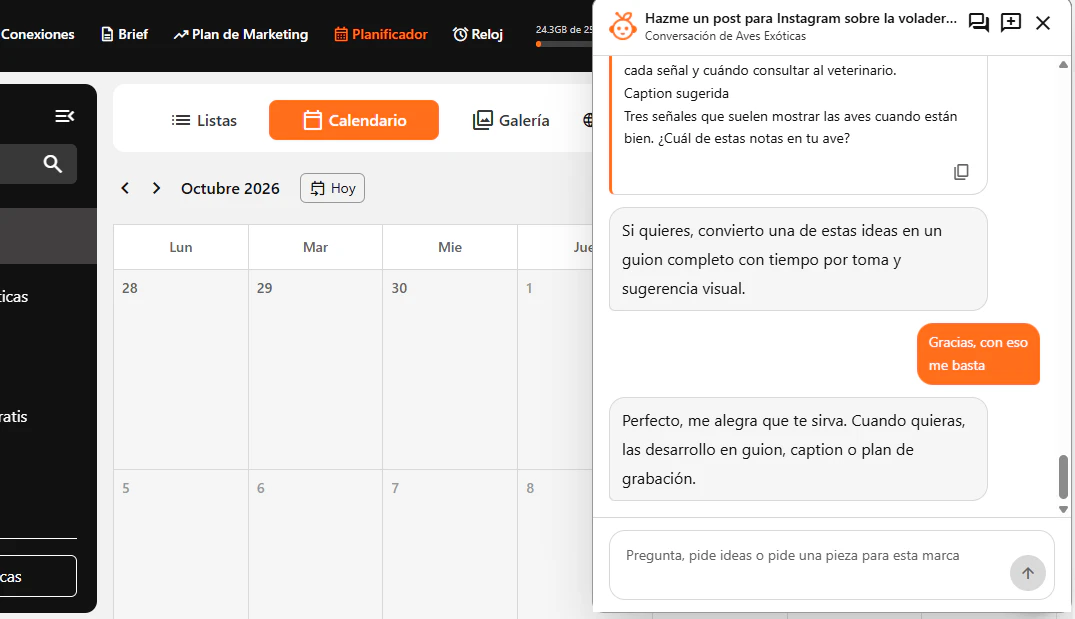
Where you feel it. On top of that context sits Emma, an AI agent you open from a floating button in the planner, available from the calendar or list view. Ask her for the month’s ideas and she comes back already knowing that brand’s pillars and tone, without you explaining a thing. You can ask her to break a topic into angles, mix up the formats, or follow a rule like “never say cheap for this brand,” and she remembers it, so every month gets sharper. The process is the same one I just walked you through. The difference is that the context stops being a doc you keep up by hand and becomes connected to where you plan.
My Final Advice
When you’re just starting out with a handful of clients, you figure everything out as you go, and it works. That’s fine. The challenge comes when the agency grows, gets more serious, and you’re no longer doing it all yourself. What you used to handle on your own now falls to a social media manager who just joined, and the question isn’t only how to create the content anymore. It’s how you pass on everything you already know about each client to that person.
That’s where I see the most value in Portal Orange. When someone starts working with you, they don’t start from zero. They can bring their own ideas and improve what’s there, but they start from a foundation that’s already in place, with each brand’s context, pillars, and rules.
So the best advice I can give you is this. Don’t wait until you’re juggling 20 or 50 clients to get organized. Even if you only have a few, start today. In fact, it’s really hard to grow to 20 or 50 clients if you haven’t nailed the heart of social media work, which is creating content in an organized way.
